The judgement
A shop floor has one job that matters more than the rest: getting a customer to look at the product long enough to pick it up. The light serves that job when it makes merchandise the brightest, clearest thing in view, and fails it when the brightness lands in people's eyes instead. Most retail lighting complaints come back to that single trade: contrast that sells versus glare that pushes people away.
That's why we treat a retail room as a contrast problem before a fitting problem. A floor lit evenly from wall to wall looks clean in a photograph and flat in person, because nothing asks to be noticed. A floor lit only with tight spots looks dramatic for a week and tiring after that, because shoppers spend their time squinting past bright points on the ceiling. The useful answer sits between them, and it changes by zone.
The product should be the brightest thing a shopper sees. The light source should be the last.
Window, floor and feature wall
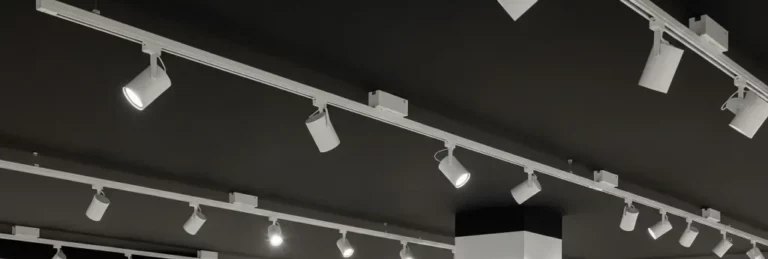
The window has to work from the pavement, often against daylight. It usually carries the strongest accent in the store, aimed so the display reads from outside without throwing light back into the street at eye level. Because window displays change often, the track there earns its keep: heads can be moved and re-aimed without new wiring.
The sales floor is where restraint pays. Tables and rails need enough accent to separate them from the aisle, but the general light still has to let people read labels and sizes. Many projects use downlights or wider heads for that general layer and keep the track for the merchandise itself.
The feature wall is the store's argument. It's often the one place where the brand wants a stronger statement, so it can take more contrast than the rest of the floor. Fitting rooms and cash desks are their own case: faces matter there, and harsh downward light is the quickest way to make a customer change their mind.
Beam and aiming, in words
A narrow beam makes a small, intense patch; a wide beam makes a broad, softer one. The same head mounted further from its target spreads its light over a larger area and looks dimmer on the surface, so the distance between the track and the merchandise matters as much as the head you pick. We'd rather describe that relationship than print a beam figure, because the right figure depends on the head, the distance and the product, and it's confirmed per model on the spec sheet.
Aiming is where glare is won or lost. Heads aimed steeply down onto a table near the aisle stay out of shoppers' eyes; heads aimed across the room toward a far wall can shine straight at someone walking the other way. Adjustable-focus COB heads, on selected models, help when one track has to serve both a close table and a distant display. Anti-glare accessories, where a model offers them, are worth asking about for any head aimed at a shallow angle.
Track layout habits that age well
Run the track parallel to the merchandise line, not to the ceiling grid, and keep it at a distance that lets heads reach the product at a comfortable angle. Leave spare length and spare heads in the plan: stores re-merchandise, and a layout that only works for opening day turns into a maintenance call within a season.
Decide early how the floor will be switched and grouped. Whether a given rail and head combination supports the grouping or dimming you want is confirmed per system, so put that question to the supplier before the ceiling closes, not after. The project sequence shows where it fits in the programme.